Travel Trends 2026: Remote Work, Travel, and Digital Nomad News
How many people will work remotely in 2026? How many digital nomads are there? We are sharing the current digital nomad statistics to shed some light on the latest remote work travel trends 2026. In 2026, over 60 countries have a visa built for remote workers and digital nomads, up from just one in 2020. Almost 18.5 million Americans now call themselves digital nomads, a 153% increase since 2019.
Remote work isn't just changing where people work anymore. It's changing how they travel, live, and plan their year, and the numbers show it happening faster than most people realize. Heading into 2026, the line between "vacation" and "work trip" keeps getting blurrier. This is why we are sharing the biggest travel trends for remote workers and traveling digital nomads in 2026 - and why anyone hiring or managing distributed teams should be paying attention.
In this article, we'll break down what's actually happening, backed by real data: the rise of the workation, new visa news for digital nomads, the numbers behind the movement, where people are going, and what it all means if you run a remote-first company.
The Rise of the Workation
A workation is a mix of work and vacation in one trip. By bringing their laptops along on their trips, people can save their vacation days and take longer trips. A workation can range from a few days to weeks or even months.
Workation is an outcome of the recent shift in remote work and high demand for more flexibility. Back in 2022, 72% of remote workers would take a workation if their employer allowed it, but only 34% actually had. Fast forward to 2026, and this gap is closing fast. According to PwC's most recent research, 51% of eligible employees now allow workations. Interest has been rising too, with around 80% of employees under age 30 saying they are interested in taking a workation. Companies are also allowing longer trips: the average approved length grew from about 30 days to over 40 days per year in just one year.
"A workation is a mix of work and vacation in one trip. Due to increasing demand, over 51% of eligible employees allow workations in 2026 and around 80% of employees under age 30 say they are interested in taking one."
Workations can have positive benefits for both the employer and employee. Fraunhofer IAO found 65% of employees report higher motivation and 71% report higher job satisfaction after a workation. A separate 2023 Ipsos study found a 27% drop in burnout symptoms, lasting about twice as long as the boost from a normal vacation.
Digital Nomad Visa News 2026
Back in 2020, only a handful of countries offered any sort of digital nomad visa. Estonia is usually credited as the first with its dedicated Digital Nomad Visa, alongside early movers like Barbados and Georgia. Now, over 60 countries offer one. Countries keep entering this space because digital nomads tend to spend meaningfully more locally than short-term tourists, without competing for jobs in the local labor market. The incredible rise in demand for workations and remote work led to many countries reflecting this in their government policy - and 2026 has already brought several concrete launches.
: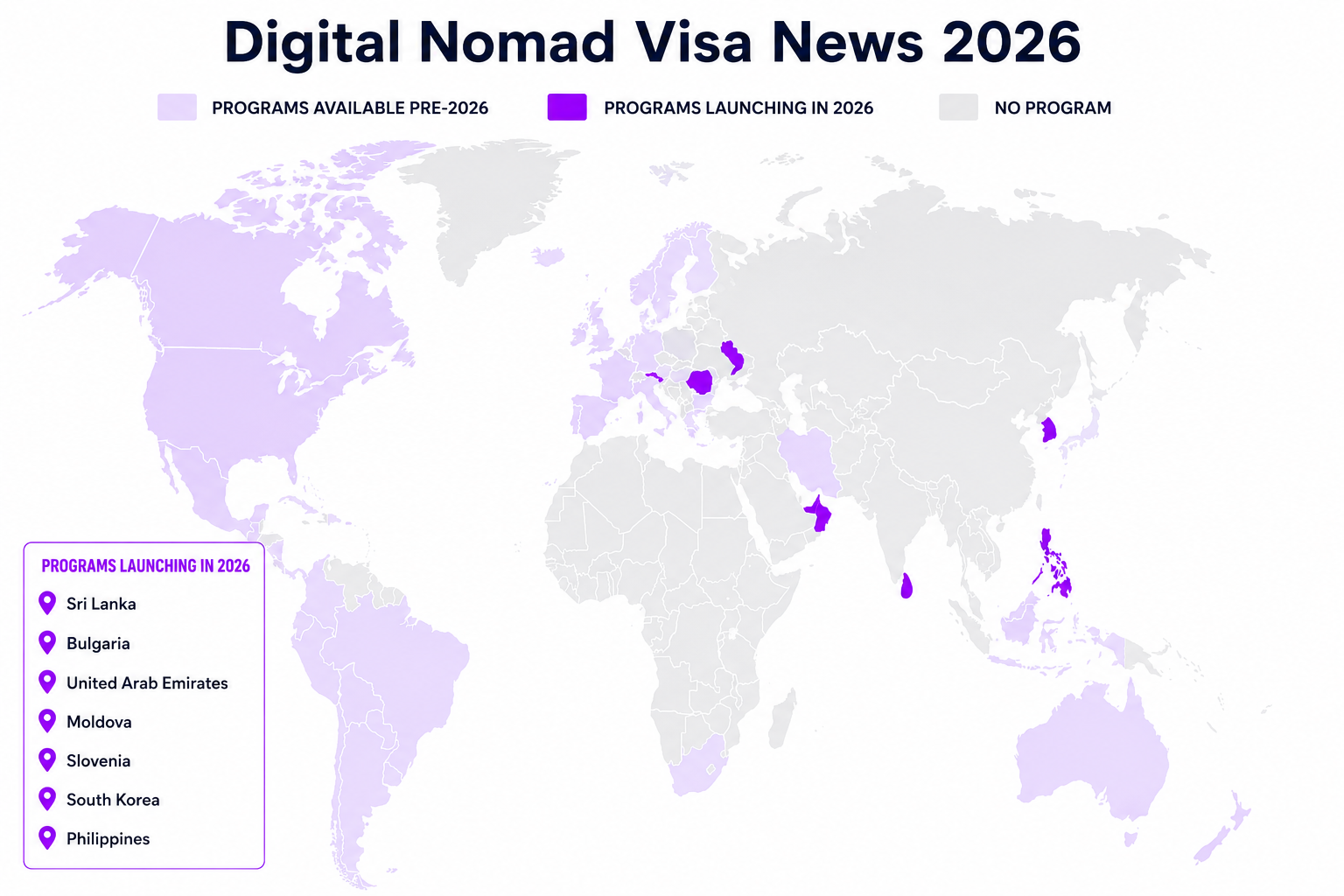
- Sri Lanka opened its first Digital Nomad Visa in February 2026. It requires proof of around $2,000 a month in income for the standard one-year permit, with a longer five-year option also available.
- Bulgaria officially launched its digital nomad visa in January 2026, using its existing Visa Type D (Long Stay) category to let non-EU remote workers live and work in the country
- The UAE rolled out a new Remote Working Visa in January 2026: a renewable 12-month residency permit that doesn't require a local sponsor.
- Slovenia launched its digital nomad program in late 2025, becoming one of Europe's newest entrants right before the 2026 wave.
- Moldova also launched in late 2025, with a comparatively low income bar among EU-adjacent countries.
- The Philippines has signed a digital nomad visa into law, but as of mid-2026 it isn't fully live yet.
- South Korea's workation visa is still in a pilot phase heading through 2026, including an income requirement.
In 2020, only a handful of countries offered any sort of digital nomad visa. In 2026, over 60 countries offer one."
Remote Work Travel by the Numbers
How many digital nomads are there in the USA or worldwide? How much money do digital nomads earn? What are the most popular digital nomad destinations in 2026? Which countries do most digital nomads come from? Let's take a look at the numbers.

- 18.5 million Americans identified as digital nomads in 2025, about 12% of the entire US workforce. That's a 153% increase since 2019.
- Global estimates vary widely, from around 40 million to as high as 80 million, with most trackers landing somewhere around 40-43 million as of 2025-2026. The gap exists mostly because nomads rarely register their status with any government, making them hard to count precisely.
- The average digital nomad earns $124,157 a year, with a median income of $85,000, per Nomad List's 2025 data - well above typical domestic salaries in many home countries.
- Younger workers dominate the population: Millennials make up about 40% of digital nomads and Gen Z about 35%, meaning these two generations account for roughly 75% of all digital nomads.
- The US supplies the largest share of digital nomads, at about 43% of the global population, followed by the UK (7%) and Canada (5%).
- Coworking spaces have roughly doubled since 2019, reaching about 42,000 worldwide by the end of 2024 accoring to per FMC Group, an indicator of how many cities are actively building out the infrastructure this kind of travel depends on.
Where Digital Nomads Are Going in 2026
Certain destinations keep showing up again and again in travel trends for remote work and digital nomad rankings this year, though which country comes out on top depends a lot on what's being measured.
The 2026 Digital Nomad Visa Index from Immigrant Invest, which weighs cost of living, tax treatment, and residency pathways, ranks Spain first, followed by Malta, Portugal, Germany, and Hungary. A separate index from Global Citizen Solutions, using a broader set of criteria including quality of life and tech infrastructure, also puts Spain in the top spot, ahead of the Netherlands and Norway.
What's actually changing in 2026 is the "why" behind these rankings:
- Affordability is overtaking lifestyle branding. Slowly but surely, countries with lower income thresholds and living costs are gaining popularity even when they're less famous as travel destinations.
- Saturation is pushing nomads toward newer hubs. Long-time popular locations like Bali and parts of Portugal are described as increasingly overcrowded and pricier than they used to be, which is steering people toward more affordable alternatives.
- Google's trending destinations for 2026 put Colombia at the top of the list, with India also standing out as 2025-2026's most affordable option for digital nomads, reflecting the trend of moving towards more affordable and less widely-known locations.
"Spain has been number one location for digital nomads for years, but cheaper, less crowded destinations like Colombia and India are quickly gaining ground as saturation pushes nomads away from old favorites."
The same trend also explains why Southeast Asia, Latin America, and parts of Eastern Europe are becoming more and more popular not only for remote workers and digital nomads but also for companies building remote teams. The same affordability and infrastructure factors that attract individual nomads are exactly what makes these regions attractive for global hiring.
What This Means for Companies
For businesses, this isn't just a lifestyle trend to observe from the sidelines and wait for it to pass. If employees want the flexibility to work from anywhere, companies need to adapt. And to adapt, they need the proper infrastructure. It is not as simple as handing someone a laptop as they move to the other side of the world for three months.
Hiring or supporting a remote worker living abroad or a digital nomad usually raises real questions: Is the company allowed to legally employ someone in that country? Who handles local taxes and compliance? What happens if a remote employee wants to switch countries every few months?
This is exactly the kind of complexity a Contractor of Record is built to solve. Instead of companies trying to figure out labor law in a dozen countries on their own, a CoR partner such as EliteBrains manages the legal and compliance side, so businesses can support a globally mobile team without the risk.
Download this article as a PDF