Grok vs ChatGPT Comparison 2026: How Many People Use Each One, Market Share, and Growth
ChatGPT has roughly 8x as many users as Grok. But Grok's user base grew almost 95% in a single quarter - nearly triple ChatGPT's pace. Here's how the two AI giants compare in 2026.
By the Numbers
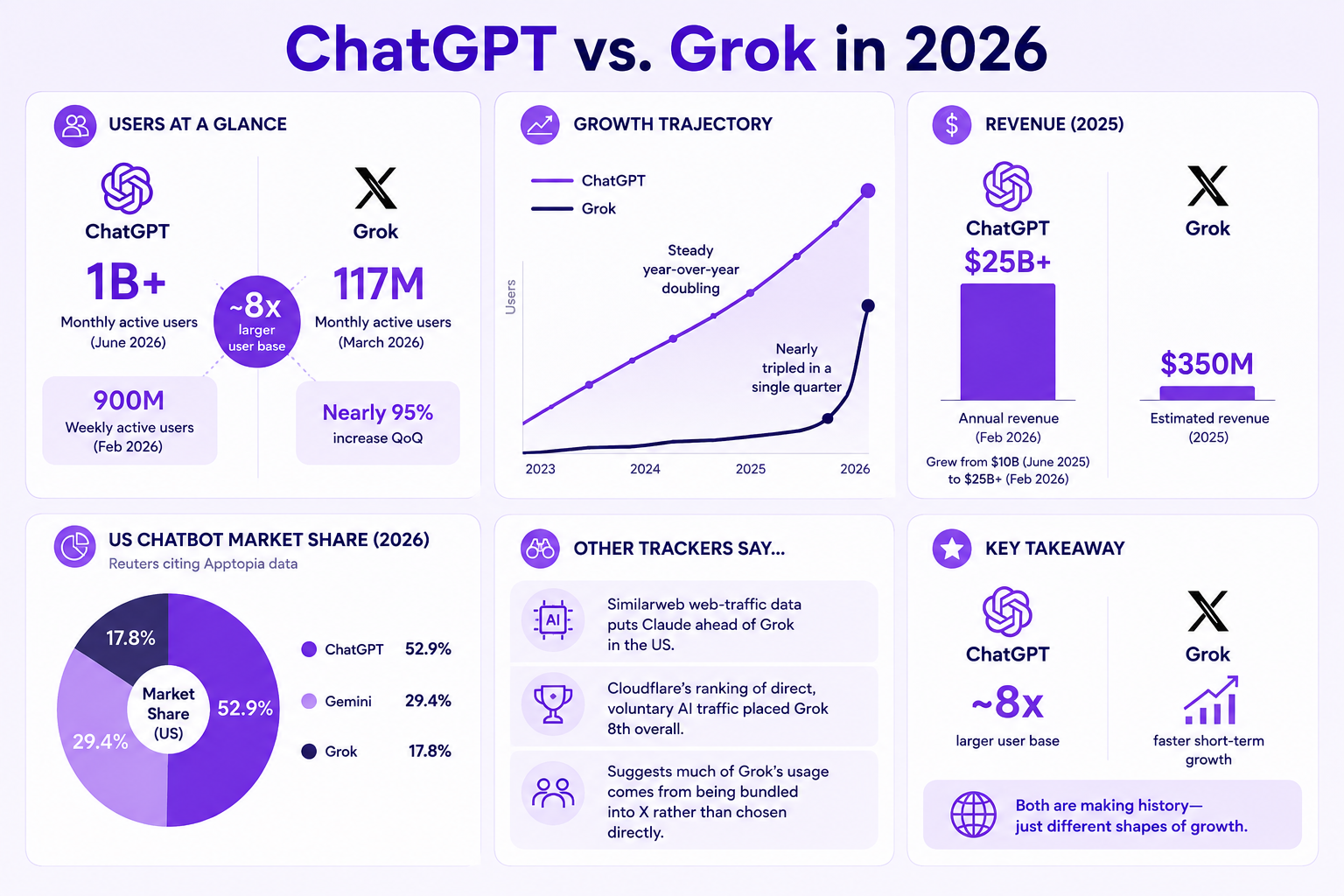
- ChatGPT: OpenAI confirmed in February 2026 they have 900 million weekly active users. By June 2026, Reuters cited a statistic showing ChatGPT app had crossed 1 billion global monthly active users making it the fastest app in history to reach that milestone, ahead of TikTok, Instagram, and Google Maps.
- Grok: based on SpaceX’s IPO filing, they had approximately 117 million monthly active users as of March 2026 - up from 35 million in December 2025 and roughly 60 million in January 2026. That is a nearly 95% jump quarter-over-quarter.
"ChatGPT has roughly 8x as many active users as Grok - but Grok's user base grew almost 95% in a single quarter, nearly triple ChatGPT's pace of growth."
- Considering those numbers, ChatGPT's user base sits at roughly 8x the size of Grok's.
- Growth trajectory: While ChatGPT’s growth has settled into a steady year-over-year doubling of their user base, Grok’s usage has nearly tripled in a single quarter. Both are historic by past software standards, just a different shape of curve.
- Revenue: Grok generated an estimated $350 million in revenue in 2025. OpenAI, by comparison, grew their annual revenue from $10 billion to more than $25 billion between June 2025 and February 2026.
- US chatbot market share: In 2026, Reuters, citing Apptopia data, reported the chatbot market share breakdown as ChatGPT 52.9%, Gemini market share at 29.4%, and Grok market share at 17.8%. Other trackers tell a different story, though: Similarweb's web-traffic data puts Claude ahead of Grok in the US, and Cloudflare's ranking of direct, voluntary AI traffic placed Grok eighth - behind ChatGPT, Claude, Perplexity, Gemini, and even DeepSeek - suggesting a large share of Grok's usage comes from being bundled into X rather than people actively choosing it.
Company and Product Background
ChatGPT launched in November 2022, and in just three years it's become one of the fastest-adopted consumer products ever. It now has a free ad-supported version, several paid plans, and a growing enterprise business. Moreover, OpenAI says most Fortune 500 companies use it in some form.
Grok launched in November 2023 as a feature bundled into X (formerly Twitter) subscriptions, before growing into its own standalone app and website. In February 2026, SpaceX acquired xAI in a deal valuing the combined company at roughly $1.25 trillion. This makes Grok part of SpaceX's broader business going forward. Its growth has been unusually fast in percentage terms, though it's still growing from a much smaller base than ChatGPT.
Feature-by-Feature Comparison
Reasoning and accuracy: Both companies release new models fast — xAI put out Grok 4.3 in April 2026, and OpenAI answered within a week with GPT-5.5. Independent tests give mixed results depending on the task: Grok tends to do better on math-heavy problems and uses fewer tokens to get there, while ChatGPT usually scores higher on broad academic tests and makes fewer factual mistakes.
Real-time information: This is where Grok clearly stands out. Because it's built into X, it has live access to posts, trending topics, and breaking news as they happen, making it a better fit for tracking fast-moving events or social conversation. Of course ChatGPT can search the web too, but it doesn't have that same real-time feed built in.
Coding: Both tools hold up well for coding work. Grok has posted strong coding benchmark results while using fewer tokens per task, which can in the end make it cheaper. ChatGPT has a more mature ecosystem around it. It has a dedicated coding agent, plus hundreds of third-party integrations. If you are just asking one-off questions, this won't make much of a difference, but if you are building whole workflows, this will matter.
Content moderation and tone: Grok is built to engage with topics other AI tools tend to avoid - political opinions, critique of public figures, and edgy or dark humor, where ChatGPT typically hedges or declines. It's also the only major chatbot with an official age-gated adult-content tier. That openness is a genuine differentiator, but it's not without cost, considering reports of Grok showing offensive material on politically sensitive topics. ChatGPT sticks to more conservative content rules, which usually makes it the safer choice for brands and enterprise use.
Multimodal features: Both generate images out of the box. Grok's image generation has faced tighter restrictions in 2026, after incidents involving misuse. ChatGPT has generally offered broader multimodal features, including video generation tools, though availability shifts as products are added or retired.
Pricing Comparison
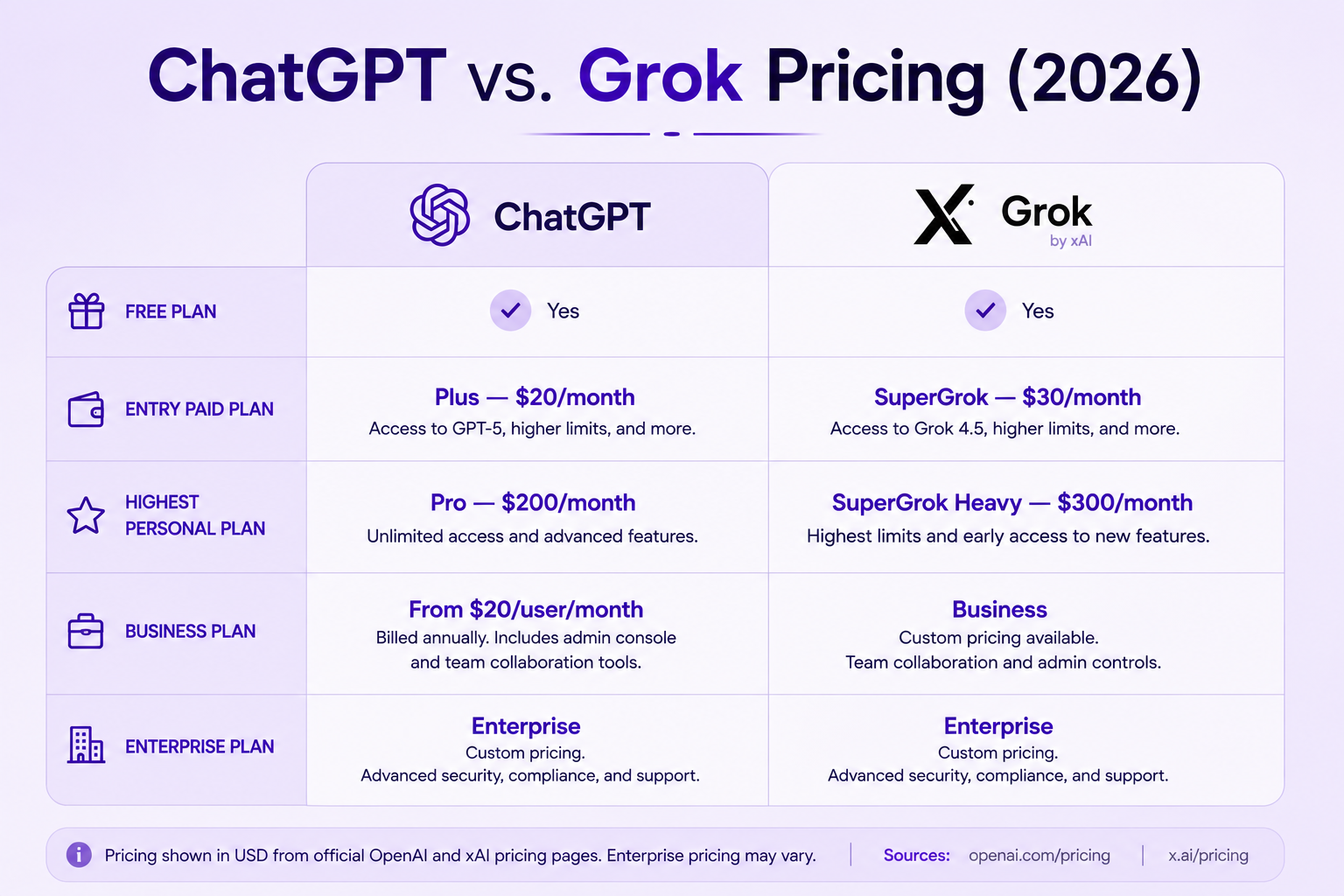
At the standard tier, ChatGPT is about 50% cheaper than Grok ($20 vs. $30 a month), and its free plan is generally more usable for people who only use it occasionally. Grok flips this on the API side, though - its per-token pricing is noticeably cheaper than ChatGPT's, which matters more to developers building with the API than to everyday chat users.
Growth and Market Trends
The interesting story here isn't the user count of each tool- it's how differently each one is growing. ChatGPT's growth has been called the fastest in the history of consumer software, and it's still gaining users at a huge scale even three years after launch. Grok, growing from a much smaller base, has actually grown faster in percentage terms for several quarters in a row - which is part of why it's climbed into third place in the US chatbot market, ahead of most other competitors.
"Grok's growth is coming more from its built-in place inside X than from people downloading it as a separate app."
It is difficult to predict whether that pace keeps up. Some trackers show Grok's US app ranking leveling off recently, even as other numbers (like its monthly active users) kept climbing. Put those two things together, and it looks like Grok's growth is coming more from its built-in place inside X than from people downloading it as a separate app.
Should you use ChatGPT or Grok?
- Best for developers and coding workflows: ChatGPT, for ecosystem maturity and integrations - though Grok is a strong, cheaper alternative on the API.
- Best for real-time information and social listening: Grok, due to its native X integration.
- Best for long-form writing and general-purpose use: ChatGPT.
- Best value at the free tier: ChatGPT.
- Best for token-efficient API use at scale: Grok.
Verdict
For most people, ChatGPT is still the safer choice: it's cheaper at the standard tier, has more features, and has a much bigger, more established ecosystem behind it. Grok's strength is narrower but real - if you care about real-time X data, a less filtered tone, or cheaper API coding costs, it's a genuine option. The bigger thing to watch is the growth gap: Grok is still much smaller than ChatGPT, but it's catching up faster than any other competitor right now.
Sources
- OpenAI, weekly active user announcement, February 27, 2026
- Reuters, citing Sensor Tower data, June 2026
- SpaceX IPO filing (xAI/Grok user figures), March 2026
- Reuters, citing Apptopia data, January 2026 US chatbot market share
Download this article as a PDF