Do I need an Entity To Hire Globally Or Can I Hire Without Setting Up a Local Entity?
Yes, but the right setup depends on the role. Compare contractor of record, EOR and your own entity - costs, compliance risk and time to hire in 2026.
Hiring globally - how it works and what are the benefits?
You are probably in a position where you need to expand your team. Hiring globally is one of the most effective ways to grow your business because it allows you to access a much larger pool of talent at more competitive rates. So you are probably one of the smart people considering this approach.
But the concern might be compliance aspects - as a founder or director, you want to make sure you stay compliant with local regulations, both in the country where your business is located and in the country where you plan to hire contractors or employees.
What to consider when hiring international stuff
That’s why we are describing the main ways to hire globally without setting up a local entity. The best way to do it depends on a combination of several factors:
- Legal expertise
- Budget
- Risk tolerance
- Team size
- Your country
- Hiring country
- Engagement type
To put this into context, we also describe what it requires to set up your own local entity.
What are the options when hiring globally without a local entity
Based on these factors, you can select one of the following options (sorted from the best to the most complicated one)
- Hire via contractor of record
- Hire via employer of record
- Learn local compliance and tax obligations and hire directly
- Or, if nothing else works for you: set up a local entity
Hiring globally - comparison table
To give you closer context, we put together a quick comparison table:
| Contractor of Record | Employer of Record | Hire directly | Setup local entity | |
|---|---|---|---|---|
| Legal expertise | Zero | Zero | High | High |
| Budget | Low - mid | High | High | Very high |
| Risk tolerance | Zero - low | Zero - low | High | Low - mid |
| Team size | Doesn't matter | Doesn't matter | Smaller teams | Bigger teams |
| Your country | Anywhere | Anywhere | Anywhere | Anywhere |
| Hiring country | Anywhere | Anywhere | Better at one country | One entity for each country |
| Engagement type | Contractors | Employees | Contractors only | Both |
Hire via Contractor of Record
One of the easiest and smoothest ways to do when hiring an international workforce is hiring via contractor of record. What does it mean? With a contractor of record (CoR), a third-party company formally contracts the contractor on your behalf. Your company signs an agreement with the CoR provider instead of directly with the contractor, while the CoR manages contracts, payments, and local compliance. This means the legal, tax, and regulatory obligations are handled by the CoR provider, not your business.
The prices for this service vary between $200 - $350/month/contractor depending on the provider.
Hire contractors via EliteBrains
EliteBrains is actually one of the platforms offering Contractor of Record service. EliteBrains has been operating in the freelance/contractor/compliance market for about 10 years and processed contracts in 100+ countries. With EliteBrains, you don’t just solve compliance and legal risks — you also get a simple way to manage your contractors. You can see all your contractors, their contracts, and timesheets in one tool. Payments are built in too, so you can handle contracts, track work, and pay people without jumping between tools — saving your HR and finance teams a lot of time every month.
On top of that, you don’t have to worry about things like misclassification risk, which can lead to heavy fines in many countries. EliteBrains handles local compliance, tax paperwork, and legal setup for you. This means you can hire globally without dealing with complex regulations or admin. Instead of spending time on legal and tax issues, you can focus on growing your team and business.
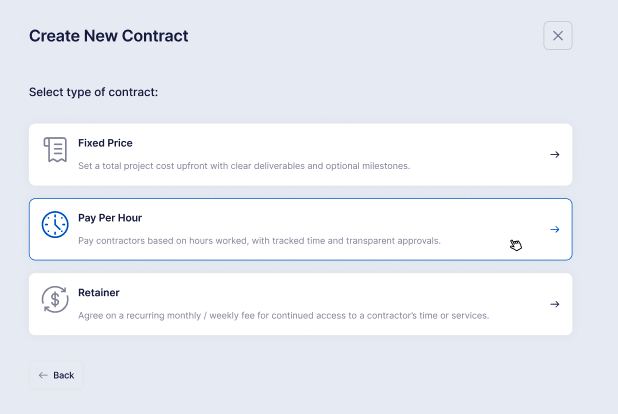
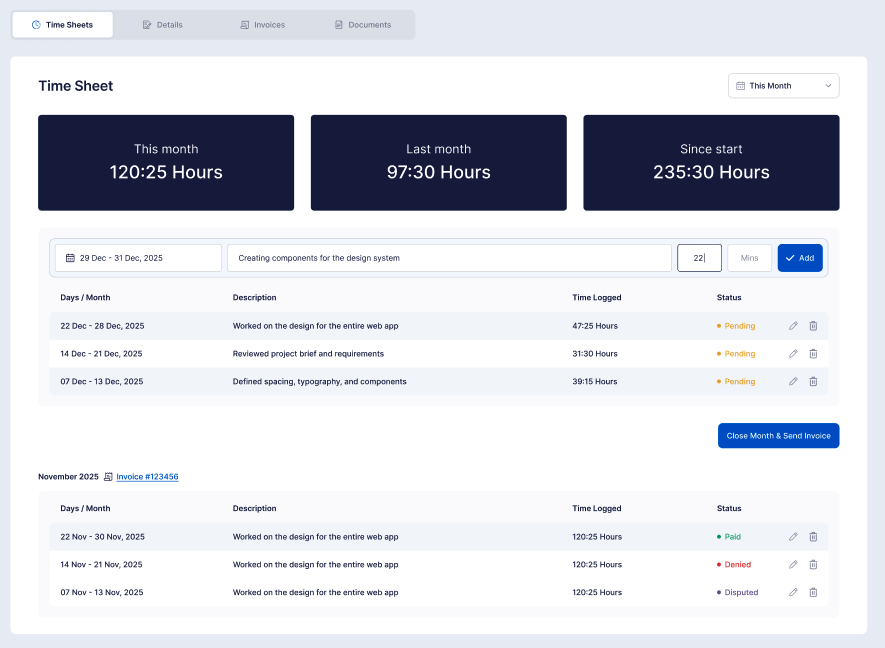
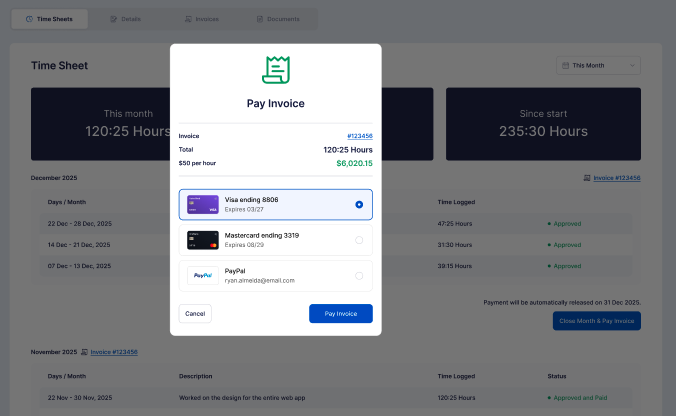
EliteBrains charges $249/month for a Contractor of Record and this is how the process works:
Step 1: Create a contract
Step 2: Approve time sheets

Step 3: Pay using predefined methods
Want to make contractor management easier? See how EliteBrains helps you manage talent, track work, handle invoices, and pay contractors globally from one place.:
How to manage contractors and global payments
Hire via Employer of Record
When hiring globally, one of the first decisions is whether to work with someone as a contractor or as an employee. The difference matters - mainly because of compliance and misclassification risk.
Contractors are independent. They usually work with multiple clients, manage their own taxes, and have more control over how and when they work. This model is flexible and often cheaper, but only works if the relationship is truly independent.
Employees, on the other hand, are part of your company. You control their working hours, tasks, and processes, and you are responsible for taxes, benefits, and local labor laws. This gives you more control, but also more obligations. If you treat someone like an employee but classify them as a contractor, you risk misclassification - which can lead to fines, back taxes, and legal issues. That’s why it’s important to choose the right model based on how you actually plan to work with the person. Another factor here is obviously the price. Costs of employees are generally much much higher and Employer of Record service provided by third-party providers is also higher than CoR. Companies are typically charging $400 - $800/month for an Employer of Record.
Learn local compliance and tax obligations and hire directly
If you have enough time and a legal team to assist you, you can hire independent contractors in specific countries directly. When hiring independent contractors in other countries, the requirements are usually simpler than hiring employees, but there are still a few important things to handle.
First, you typically need a contract agreement that clearly defines the relationship (to show the person is truly independent). This is important for compliance and to avoid misclassification as mentioned earlier.
Second, you may need to collect tax information from the contractor. For example, in the US they require W-8 or W-9 form. In other countries like Brazil, Poland, Czech Republic, Pakistan etc.,contractors often provide their local tax ID or business registration details.
In some cases, you might need to report payments to tax authorities, depending on your country’s rules. This is more common when working with domestic contractors, but can also apply internationally. You also need to make sure you are not treating the contractor like an employee - meaning they should have control over their work, schedule, and tools. As said in the beginning, if you have enough time and strong legal background you can prevent all of these risks by yourself. But in most cases it is just so much easier to cooperate with a third-party provider and hire via Contractor of Record.
In certain countries, you may need to register with local authorities or follow specific invoicing rules, especially if you are paying contractors regularly. And finally, you need a way to pay contractors internationally, which can include bank transfers, payment platforms, or other payout methods. Part of EliteBrains platform is also managing payments and paying contractors internationally, so if you want to focus on your business core rather than dealing with compliance, tax and payments, using a third-party provider is a way to go.
Overall, while hiring contractors is more flexible, you still need to handle contracts, tax forms, compliance, and payments correctly.
Set up a local entity
The headline of the article is how to hire without a local entity, but to give you a full picture of all available options, it’s also important to understand how this approach works. Setting up a local entity means you officially establish your company in a foreign country. This usually involves registering the business, opening a local bank account, and dealing with local tax authorities and regulations. Once the entity is set up, you can hire employees directly under your company in that country. This approach gives you full control, but it also comes with higher costs, more admin work, and ongoing compliance obligations. You need to handle local payroll, taxes, employment laws, and reporting. In many cases, it can take weeks or even months to fully set everything up. That’s why this option usually makes sense only if you plan to build a larger team in that country or have a long-term presence there.
Setting up a company in another country usually requires both one-time steps at the beginning and ongoing work every month or year.
At the beginning (one-time setup):
- Register the company with local authorities
- Choose company structure (e.g. LLC, Ltd)
- Prepare legal documents (articles of association, etc.)
- Open a local bank account
- Register for taxes (corporate tax, VAT if needed)
- Get any required licenses or permits
- Set up a local address (sometimes required)
- Hire an accountant or legal advisor
Ongoing (monthly / yearly):
- Accounting and bookkeeping
- Payroll processing (if you have employees)
- Tax filings (corporate tax, VAT, etc.)
- Salary taxes and social contributions
- Annual financial statements
- Compliance reporting to local authorities
- Renew licenses if required
- Manage contracts and local legal obligations
In short: setting up a local entity gives you full control, but it also means ongoing admin, costs, and responsibility for compliance in that country.
Based on all of the factors above, the easiest way to hire globally without a local entity is to hire via a contractor of record. EliteBrains provides a Contractor of Record service together with skill assessments, which simplifies the entire hiring process and makes it as seamless as possible.
Download this article as a PDF